
Starting a Gutter Clearing Business: What Equipment Do You Need?
Starting a gutter clearing business? Learn which equipment matters on day one, what can wait and how to build a professional setup around real jobs.

On this page
You do not need every gutter-clearing accessory, the longest carbon-fibre pole kit and a fully fitted van before you can start taking professional jobs.
You do need a complete working system that can handle the properties you intend to service safely and reliably.
For most new gutter-clearing businesses, the core setup is a suitable gutter vacuum, enough compatible high-reach pole sections, hose, neck and nozzles, a reliable power arrangement, basic job-specific safety equipment and a practical way to transport everything.
An inspection camera, spare parts and additional tools can strengthen the service quickly, but they should support the work rather than distract from getting the fundamental setup right.
What equipment do you need to start a gutter clearing business?
| Equipment | Priority | Why it matters |
|---|---|---|
| Gutter vacuum | Essential | Creates the suction and collects removed debris |
| Gutter-vacuum poles | Essential | Provide the high-reach suction route |
| Hose and fittings | Essential | Connect the machine and pole system without unnecessary leaks or restrictions |
| Neck and nozzles | Essential | Position the suction opening inside the gutter and deal with different debris and access |
| Suitable power supply | Essential | Runs the vacuum correctly at mains-powered and remote jobs |
| Task-appropriate PPE and safety equipment | Essential | Supports the risk controls required for the work being undertaken |
| Inspection camera | Very useful | Helps with surveys, quotations, tool positioning and before-and-after evidence |
| Correct spare parts | Very useful | Prevents simple filter, cuff or attachment problems ending a working day |
| Van or suitable vehicle | Usually necessary in practice | Transports the machine, poles, hose and associated equipment securely |
The right specification within each category depends on the jobs you expect to take on.
1. Start with the right gutter vacuum
The vacuum is the centre of the system, but the biggest machine is not automatically the best first machine.
Think about:
- the height and size of the properties you expect to service;
- how frequently the machine will be used;
- whether work is mainly residential or includes larger commercial sites;
- the type of debris you commonly expect;
- drum capacity;
- machine size and portability;
- the power supply available;
- and the pole and hose system you intend to pair with it.
A compact professional vacuum can make excellent sense for a new operator working mainly on ordinary domestic properties.
A larger multi-motor machine may be more appropriate where higher airflow, larger capacity or regular demanding commercial work justifies the additional size and power requirements.
Buy for the workload you are building, not purely for the largest specification you can afford.
Our guide to gutter vacuum airflow, water lift and wattage explains how to compare machine specifications properly.
2. Choose enough pole reach for real properties
The pole system determines where the working end can be positioned from the ground.
Do not choose reach purely from phrases such as:
“Most of my work will be two-storey.”
Two properties with the same number of storeys can have very different gutter heights and access.
Extensions, conservatories, walls, fences and sloping ground can all force you further from the building and increase the amount of pole required.
A sensible starter system should cover the type of properties you genuinely expect to quote without forcing you to use every pole section on every job.
Aluminium or carbon fibre?
You do not need carbon fibre to run a professional gutter-clearing business.
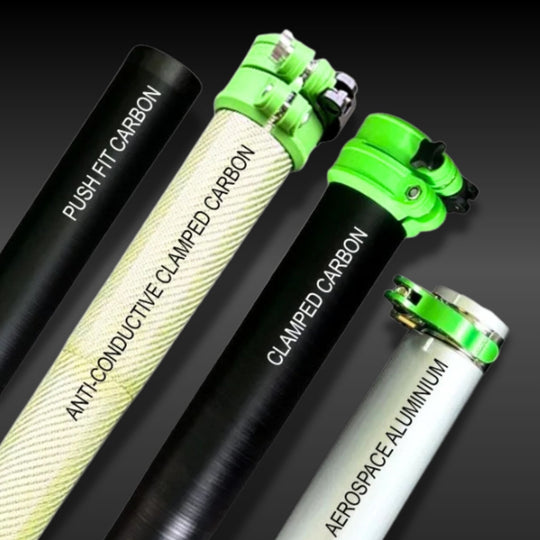
Aerospace aluminium provides a cost-conscious professional route where its additional weight is acceptable.
Carbon fibre becomes increasingly attractive as reach and frequency of use increase because lower pole weight can make long configurations easier to handle throughout the working day.
Our carbon fibre vs aluminium gutter-vacuum pole guide covers that decision separately.
3. Make sure the hose, neck and nozzles form one compatible system
A powerful vacuum and good pole kit will still perform poorly if the suction route is badly matched.
The complete path is:
nozzle → neck → poles → hose → vacuum.
Make sure:
- hose diameter suits the system;
- cuffs and joiners are properly matched;
- the neck fits the pole architecture;
- the nozzles fit the chosen neck;
- and every connection seats properly without unwanted air leaks.
For a first setup, a small selection of genuinely useful nozzles is normally better than buying every specialist attachment available.
A useful starter selection might cover:
- general gutter debris;
- breaking up or agitating difficult material;
- and narrower restricted-access areas.
Add specialist tools once actual jobs show you where the standard setup is limited.
4. Plan the power supply before the first job
An electric gutter vacuum is only useful if you can supply it correctly on site.
Some jobs provide suitable mains power. Others may require a generator.
The power requirement depends on the vacuum.
For example, current GVS professional machines have different minimum generator requirements, so do not buy a small generator simply because the plug physically connects to it.
Check:
- vacuum voltage;
- maximum electrical demand;
- manufacturer generator guidance;
- plug and socket arrangement;
- extension-lead specification;
- cable condition;
- and the electrical protection required by the equipment.
If most early jobs have reliable mains access, a generator may not need to be your first purchase.
If remote power is common in your target market, it becomes much more important.
The GVS Generators & Extension Leads collection provides the relevant equipment route once you know the vacuum being powered.
5. Build safety into the equipment list
Working from the ground can avoid the need to physically access many gutters at height, which is a major advantage of professional high-reach equipment.
It does not make every gutter-clearing job automatically safe.
Before work, consider:
- overhead power lines;
- the space required to raise and lower poles;
- ground conditions;
- wind and weather;
- members of the public;
- vehicles and traffic;
- falling debris;
- electrical equipment and cables;
- and the manual handling of the machine and collected waste.
PPE should follow the actual risk assessment rather than being treated as a generic shopping list.
Depending on the work, that may include suitable eye protection, gloves, footwear, high-visibility clothing or other protective equipment identified by the task and location.
The important point is that PPE sits at the end of a wider control process. It does not replace sensible positioning, keeping people away from the working area or avoiding an electrical hazard.
Use the GVS Health & Safety Hub when building your working procedures.
6. Is an inspection camera essential?
No.
A gutter vacuum can operate and remove debris without a camera.
But for a professional business, inspection is one of the upgrades that can improve the service quickly.
A suitable camera can help you:
- inspect gutters before quoting or clearing;
- understand the amount and location of debris;
- identify awkward working areas;
- monitor difficult sections;
- check the visible result afterwards;
- and provide before-and-after evidence for the customer.
This is particularly useful because the customer often cannot see the gutter from ground level.
Our gutter inspection camera guide explains how to build inspection into the professional workflow.
7. Carry a small number of useful spares
A professional setup becomes more reliable when a minor component failure does not automatically end the working day.
You do not need a mobile warehouse.
Useful spares depend on the machine, but may include:
- a correct spare filter;
- a commonly used hose cuff or joiner;
- small compatible connection parts;
- and frequently used working-end attachments.
A £10–£20 component can be more commercially important than another large accessory if it prevents you abandoning a booked job.
Keep spares specific to the equipment you actually own rather than accumulating generic parts that only appear compatible.
Use the GVS Spare Parts & Compatibility Guide when identifying replacements.
8. Do you need a van?
You do not legally need to own a van simply because you start a gutter-clearing business.
You do need a suitable way to transport the equipment safely and practically.
A typical professional setup can include:
- a large wet-and-dry vacuum;
- multiple pole sections;
- several metres of hose;
- working-end attachments;
- inspection equipment;
- extension leads or a generator;
- PPE;
- spares;
- and collected equipment that may be wet or dirty after the job.
For many businesses, a van therefore becomes the practical choice quite quickly.
Whatever vehicle is used:
- check its permitted payload;
- secure heavy equipment properly;
- protect long pole sections;
- keep electrical equipment away from unnecessary moisture;
- and organise the load so the equipment used most often remains accessible.
A van is not properly organised simply because every item can be squeezed inside.
What business requirements should you check?
The equipment is only one side of operating professionally.
Insurance
Tell your insurer what work the business actually carries out.
Public-liability cover is commonly relevant to contractors working at customers' properties, while Employers' Liability insurance is generally a legal requirement once a business becomes an employer, subject to the statutory exemptions.
If a vehicle is being used for business activity, make sure its insurance also reflects that use.
Do not assume a policy arranged for window cleaning, gardening or general property maintenance automatically covers every gutter-clearing activity you later add.
Waste
If you remove gutter debris from a customer's property and transport it away as part of the business, waste-carrier requirements may apply.
In England, businesses transporting waste generally need to register with the Environment Agency. Transporting someone else's waste is treated differently from carrying only waste produced by your own business.
Scotland, Wales and Northern Ireland have their own regulatory arrangements, so check the rules that apply where the business operates.
Do not simply put collected gutter debris into whichever commercial or domestic waste route is most convenient without checking that it is appropriate.
Risk assessment and working procedures
Professional status does not come from owning commercial equipment.
You need a repeatable way to assess properties, choose equipment, control the working area, deal with electrical hazards and know when a job falls outside the method you are equipped to provide.
That becomes even more important when employees or subcontractors begin carrying out work on behalf of the business.
What can wait until the business grows?
One of the easiest ways to overspend at the start is buying equipment for work you do not yet have.
You can often delay:
- the maximum possible pole reach if your current properties do not need it;
- multiple specialist neck angles;
- large numbers of specialist nozzles;
- premium inspection equipment where a simpler compatible system meets the current requirement;
- a generator if reliable mains power is available on virtually every early job;
- equipment for window cleaning, roof cleaning, softwashing or pressure washing before those services are actually being offered;
- and large quantities of spare parts that your system rarely consumes.
Buy upgrades when they solve a repeated limitation.
If several enquiries are lost because you cannot reach a particular height, additional supported reach becomes easier to justify.
If customers repeatedly ask for before-and-after evidence, a camera moves up the priority list.
If mains power regularly prevents you accepting work, a generator becomes an operational requirement rather than an optional extra.
Three sensible ways to build a starter setup
| Starting position | Equipment priority |
|---|---|
| Cost-conscious domestic start | Suitable professional vacuum, aluminium or appropriate carbon pole kit, core nozzles, hose, safe mains-power setup and essential PPE |
| Full-time professional setup | Vacuum matched to regular workload, lower-weight pole system, broader working-end options, inspection camera, useful spares and organised vehicle storage |
| Higher-reach / mixed commercial work | Vacuum and pole system selected for greater reach and workload, reliable independent power where required, inspection capability, spares and a carefully planned transport system |
These are approaches, not fixed bundles.
The actual machine and pole combination should follow the jobs, working height, access and available power.
If you prefer to start from systems where the principal vacuum and pole components have already been brought together, compare the complete GVS gutter-vacuum packages.
What should your first investment achieve?
Your first setup should allow you to complete the work you are actually selling without relying on improvisation.
Before spending more, ask whether the current equipment lets you:
- reach the gutters you regularly quote;
- remove the debris you commonly encounter;
- power the vacuum reliably;
- transport the equipment properly;
- work with a sensible risk-control process;
- and finish the job to a standard you are comfortable showing the customer.
If the answer is yes, the next purchase does not need to happen simply because another accessory exists.
Our practical recommendation
Start with one complete, dependable gutter-clearing system rather than several incomplete services.
Prioritise:
- a gutter vacuum suited to the intended workload;
- enough compatible pole reach;
- the correct hose, neck and core nozzles;
- a reliable power arrangement;
- task-appropriate safety equipment and working procedures;
- a practical transport setup;
- then inspection equipment and useful spares.
Once those foundations are working well, let customer demand tell you where to invest next.
That might mean greater reach, a better inspection workflow or eventually another exterior-cleaning service.
If you reach that stage, our guide to expanding beyond gutter clearing explains how to add services without buying several unrelated systems at once.
A professional business does not need every tool on day one.
It needs the right tools for the jobs it agrees to do — and a plan for adding the rest when there is a real reason to own them.
Quick Answers
Frequently Asked Questions
Find concise answers to common questions covered by this guide.
Can you start a gutter clearing business with one gutter vacuum?
Do I need carbon fibre poles to start a gutter cleaning business?
Do I need a gutter inspection camera?
Do I need a generator for a gutter vacuum?
Do I need a van to start a gutter clearing business?
Do I need insurance for a gutter cleaning business?
Do I need a waste carrier registration for gutter debris?
What gutter vacuum spares should I carry?
Related Advice
Keep Learning
Continue with related GVS guides before moving into equipment or support.

Continue From Here
Use The Guide, Then Choose What To Do Next
Keep researching or move into the most relevant GVS equipment or support area for this topic.
Need A Product-Specific Answer?
Need Help Applying This To Your Setup?
Tell the GVS team what you are cleaning, your working height and the equipment you already have. We can help you check the practical next step.