
How High Can a Gutter Vacuum Reach? Pole Length vs Working Height
Pole length is not the same as working height. Learn how angle, operator position, obstacles and working-end geometry affect real gutter vacuum reach.

On this page
A 20ft gutter-vacuum pole kit does not automatically mean every gutter 20ft above the ground will be comfortably within reach.
Likewise, a 40ft pole configuration should not be interpreted as a guarantee that every 40ft-high gutter can be cleared effectively from whatever position is available below.
Pole length tells you how much pole you have. Working height tells you where the nozzle can actually be positioned and controlled on the property.
The difference depends on the angle of the pole, where the operator can stand, obstacles around the building, ground level and the neck and nozzle fitted at the working end.
How high can a gutter vacuum reach?
Professional gutter-vacuum systems can provide substantial high-level reach while allowing the operator to remain at an appropriate position below.
The current GVS gutter-vacuum pole range includes configured systems up to 40ft, with the exact available lengths varying by pole family.
Those figures are best understood as nominal pole configurations, not guaranteed gutter heights.
A useful rule is:
The more of the pole that has to reach across as well as up, the less of its length is contributing purely to vertical height.
You can compare the current GVS gutter vacuum pole kits once you have established the height and access conditions you actually need to work with.
Pole length and working height are not the same thing
Imagine a gutter directly above an open section of level ground.
The operator may be able to stand relatively close to the building and keep the pole fairly upright. In that situation, much of the assembled pole length contributes towards vertical reach.
Now place a conservatory beneath the same gutter.
The operator may need to stand several metres further back and angle the pole over the obstruction.
The gutter itself has not moved.
The pole has not become shorter.
But the geometry has changed considerably.
Part of the pole length is now being used to span the horizontal distance between the operator and the building.
This is why two gutters at the same measured height can require different pole configurations.
What do 20ft, 30ft and 40ft pole figures actually mean?
These nominal figures are useful ways of comparing the amount of pole supplied.
| Nominal configuration | Approximate length | What the figure tells you | What it does not guarantee |
|---|---|---|---|
| 20ft | About 6.1m | The approximate assembled pole length | Comfortable access to every gutter 20ft above ground |
| 30ft | About 9.1m | A longer pole configuration for greater-reach work | That every 30ft gutter can be controlled effectively from the available position |
| 40ft | About 12.2m | A substantial professional high-reach configuration | That every gutter around 40ft high is suitable for that ground-based setup |
The final working position may end up slightly above or below the bare pole figure depending on how the pole is held and the geometry of the neck and nozzle.
That is why the number should be treated as an equipment specification rather than a property-height promise.
What affects real gutter-vacuum reach?
How far you stand from the building
Standing further back reduces the amount of pole length available purely for vertical reach.
This is one of the biggest real-world reasons a pole that appears long enough on paper may still be marginal on a particular property.
Extensions and conservatories
Single-storey extensions, conservatories, porches and car ports can force the operator to reach both upwards and across.
A lower gutter across a deep extension can sometimes demand more pole than a higher gutter on a clear elevation.
Fences, planting and restricted ground access
Flower beds, walls, fencing, vehicles and other obstacles can prevent the operator from standing in the position that would provide the most efficient pole angle.
Sometimes a different working position solves the problem. Sometimes additional supported reach helps. In other situations, the proposed ground-based method may simply not be appropriate for that section of the property.
Ground level
Do not assume every elevation of a property starts from the same level.
Sloping sites, basement areas, terraces and retaining walls can change the distance from the operator's feet to the gutter considerably.
Assess the height from the place where the operator will actually stand.
The operator's holding position
The bottom of the pole is normally controlled above ground rather than starting exactly at the operator's feet.
That contributes to the final elevation of the working end, but it should not be turned into a simplistic calculation such as:
20ft pole + 6ft operator = guaranteed 26ft working height.
The amount of useful additional height changes with stance, pole angle and the amount of control required.
The neck and nozzle change the final working geometry
The last pole section does not normally point directly at the debris.
A neck changes the direction of the suction route so that the nozzle can sit inside the gutter.
Different neck geometries can therefore alter the position of the nozzle relative to the top of the pole.
A 90° arrangement, a 135° neck and a more sharply curved working end do not place the nozzle in exactly the same position.
This can help solve an access problem, but a different neck should not be used as a substitute for genuinely insufficient pole length.
The neck's job is to create the correct approach into the gutter.
Our rigid vs flexi gutter vacuum neck guide explains the working-end decision separately.
Greater reach also changes how the poles feel
Being able to lift a nozzle to a particular height is not the same as being able to work there efficiently.
At greater reach, the operator still needs to:
- raise the assembled system;
- position the nozzle inside the gutter;
- move it around brackets and obstacles;
- control it while debris is being removed;
- reposition the poles along the property;
- and lower the equipment afterwards.
This is why pole weight and rigidity become increasingly important as the configuration gets longer.
Weight
Every additional section adds mass, and much of that mass is being controlled away from the body.
The working end may also carry a neck, nozzle and camera equipment.
Lower section weight therefore becomes progressively more valuable for regular greater-reach work.
Rigidity
Movement at the operator's hands becomes more noticeable at the far end of a long pole system.
A useful balance of weight and rigidity makes accurate positioning easier.
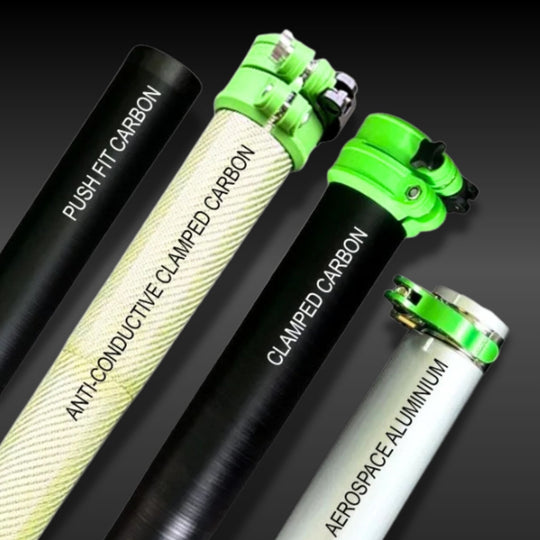
This is one reason carbon fibre is particularly popular for longer professional configurations, although aluminium can still provide substantial reach where its additional weight is acceptable.
Our carbon fibre vs aluminium gutter vacuum pole guide covers that choice in detail.
Wind and weather
Long-reach poles become harder to control when conditions deteriorate.
There is no useful universal wind figure at which every gutter-vacuum pole becomes safe or unsafe. Pole length, attachments, property shelter and the complete working situation all matter.
If conditions prevent the equipment from being raised, controlled or lowered safely, maximum advertised reach is irrelevant.
Can you simply keep adding more pole sections?
Use the pole system within the configurations intended and supported for that equipment.
The fact that another section can physically be connected does not mean the pole should be extended indefinitely.
Every additional section changes:
- weight;
- leverage;
- movement at the working end;
- the way the system is raised and lowered;
- and the operator's ability to control it.
GVS currently provides gutter-vacuum pole kits in established configurations up to 40ft across relevant pole families.
If your expected work regularly sits beyond the normal configuration of the system you are considering, choose equipment designed for the actual requirement rather than assuming unlimited extension is the answer.
How to choose the right pole length
Start with the properties you genuinely expect to service.
1. Establish the approximate gutter height
Do not rely purely on descriptions such as “two-storey” or “three-storey”.
Buildings with the same number of floors can have very different eaves heights.
Where reach is close to the limit of a proposed setup, establish the height using a suitable ground-based measuring method rather than guessing.
2. Assess where you can stand
Look at the ground below and around the gutter.
Can you work reasonably close to the elevation, or will something force you backwards?
3. Allow for horizontal reach
Think about extensions, conservatories and other obstacles before matching a nominal pole figure to the measured gutter height.
4. Consider the working end
Which neck and nozzle will be needed, and where does that place the suction opening relative to the final pole section?
5. Consider handling as well as theoretical reach
The objective is not merely to touch the gutter with the nozzle.
You need enough control to clear it effectively.
6. Leave a sensible working margin
If nearly every expected job would place a shorter kit at the absolute edge of its practical capability, choosing additional supported reach can provide more flexibility than constantly trying to extract the final few centimetres from the setup.
That does not mean buying the maximum configuration available regardless of need.
Modular poles allow you to use fewer sections on lower jobs.
Inspection becomes more valuable at greater reach
As the working end moves further away, direct visibility into the gutter usually becomes more difficult.
A compatible inspection camera can help the operator:
- find concentrations of debris;
- position the nozzle;
- check awkward areas;
- and inspect the visible result afterwards.
The camera does not extend the pole or increase the vacuum's suction.
It improves visibility at the reach you already have.
You can read our gutter inspection camera guide or browse GVS gutter inspection camera kits.
Ground-based reach still needs a safe working method
High-reach pole equipment can allow suitable gutter-clearing tasks to be completed while the operator remains at ground level, avoiding the need to physically access the gutter in many situations.
That is a meaningful benefit, but it does not make a long pole automatically safe to use wherever it can physically reach.
Before raising the system, assess:
- overhead power lines and electrical equipment;
- ground condition;
- wind and weather;
- pedestrians and vehicles;
- restricted areas;
- the space needed to raise and lower the pole;
- and whether the complete configuration can be controlled properly.
HSE guidance for high-level cleaning recognises telescopic pole systems as a way to avoid physical work at height where reasonably practicable, while still requiring the work and equipment to be properly planned and suitable for the task.
Overhead electricity deserves particular attention
Long poles can enter an electrical danger area while they are being raised, lowered or repositioned.
Electricity can flash across a gap, so direct contact with an overhead line is not required for a serious incident.
Do not use pole material or maximum reach as a substitute for controlling an electrical hazard.
Use the GVS Health & Safety Hub and current HSE electrical safety guidance where relevant.
Our practical recommendation
Treat the advertised pole length as the amount of pole supplied, not a guarantee about the building.
Choose enough supported reach for the actual properties you expect to service, taking account of where you can stand and how much horizontal distance the pole may need to cover.
At greater reach, give increasing weight to:
- pole mass;
- rigidity;
- working-end control;
- inspection visibility;
- and the conditions in which the complete system will be raised and lowered.
A 40ft configuration can provide substantial professional reach, but the correct question is never simply:
“Can the nozzle get that high?”
It is:
“Can this gutter be reached, cleared and the equipment controlled properly from the working position available?”
That is the difference between theoretical pole length and useful working height.
Quick Answers
Frequently Asked Questions
Find concise answers to common questions covered by this guide.
How high can a gutter vacuum reach?
Does a 20ft gutter vacuum pole reach a 20ft gutter?
Does my height add to the pole reach?
Why can't I reach a gutter even though my poles are long enough?
Can I add another pole section for more reach?
Is carbon fibre better for high gutters?
Does a longer hose give me more gutter height?
Can I use gutter vacuum poles near overhead power lines?
Related Advice
Keep Learning
Continue with related GVS guides before moving into equipment or support.

Continue From Here
Use The Guide, Then Choose What To Do Next
Keep researching or move into the most relevant GVS equipment or support area for this topic.
Need A Product-Specific Answer?
Need Help Applying This To Your Setup?
Tell the GVS team what you are cleaning, your working height and the equipment you already have. We can help you check the practical next step.