
Carbon Fibre vs Aluminium Gutter Vacuum Poles: Which Should You Choose?
Compare carbon fibre and aluminium gutter vacuum poles for weight, rigidity, reach, durability and connection type before choosing your pole system.

On this page
Carbon fibre and aluminium can both make excellent professional gutter-vacuum pole systems, but they suit different priorities.
Carbon fibre is usually the better choice when keeping pole weight down matters most, particularly for frequent work and greater reach. Aluminium provides a robust, cost-conscious alternative that can make very good sense for lower or moderate reach and operators who prefer its working feel.
Material is only part of the decision, though.
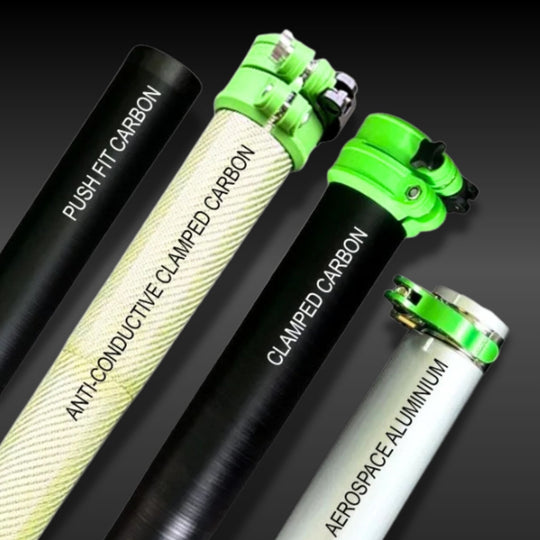
GVS gutter-vacuum poles also differ by section length, diameter and connection system. A 51mm push-fit carbon pole, a 51mm clamped carbon pole and a 51mm aerospace aluminium pole may all belong to the same broad equipment category while feeling and connecting differently in use.
The best choice is therefore not simply carbon or aluminium? It is:
Which complete pole system gives you the weight, reach, connection and compatibility your work requires?
Carbon fibre vs aluminium gutter vacuum poles: quick comparison
| Consideration | Carbon fibre | Aerospace aluminium |
|---|---|---|
| Weight | Lower-weight options are available, particularly in the full-carbon GVS ranges | Heavier per comparable amount of pole, but still purpose-designed for high-reach gutter clearing |
| Reach | Particularly attractive when multiple sections are regularly used | Capable of substantial professional reach where the additional weight is acceptable |
| Working feel | Low weight can make longer configurations easier to manoeuvre | Firm, robust-feeling construction with a different balance in use |
| Impact behaviour | Can be damaged by cracking, crushing or severe impact | Can dent or bend if heavily damaged |
| Connection options | Available in push-fit, clamped and different diameter systems | Uses its own compatible 51mm connection arrangement |
| Electrical protection | Standard carbon fibre must not be treated as electrically safe | Aluminium is conductive and must not be treated as electrically safe |
| Best overall? | Neither universally - choose around reach, frequency, handling, compatibility and budget. | |
You can compare the wider GVS gutter vacuum pole range once you have decided which characteristics matter most to your work.
How much lighter are carbon fibre gutter vacuum poles?
The current GVS range provides useful real-world examples, but section length needs to be considered alongside weight.
| GVS pole type | Section length | Diameter | Approx. section weight |
|---|---|---|---|
| Aerospace aluminium | 1.2m | 51mm | 500g |
| Full-carbon push fit | 1.5m | 51mm | 360g |
| Full-carbon clamped | 1.5m | 51mm | 430g |
| Carbon-fibre composite push fit | 1.5m | 44mm | 330g |
The figures make one point particularly clear: carbon-based GVS options can provide more pole length per section while still weighing less than the shorter aluminium section.
But the table should not be used to declare one pole universally superior.
The 44mm carbon-fibre composite system is a different diameter and construction from the 51mm full-carbon systems. The clamped and push-fit 51mm carbon poles also use different connection arrangements. The correct comparison is between complete systems that suit the job you intend to do.
Why does pole weight matter more at greater reach?
Additional weight becomes increasingly noticeable as more sections are assembled.
The operator is not simply holding the total pole mass close to the body. Much of that weight is distributed several metres away, together with the neck, nozzle and any compatible inspection-camera equipment at the working end.
That is why reducing the weight of each pole section becomes more valuable as:
- working height increases;
- more sections are used;
- the pole is raised and lowered repeatedly;
- or gutter clearing forms a large part of the working day.
For occasional work at modest reach, the difference may matter less.
For a professional repeatedly working with long configurations, it can become a significant part of the buying decision.
Our guide to gutter vacuum pole length and working height explains why nominal pole length and practical working reach are not quite the same thing.
Does carbon fibre automatically mean a more rigid pole?
No. Material alone does not tell you how a finished pole system will behave.
Rigidity is influenced by:
- diameter;
- wall construction;
- material lay-up or composite construction;
- section length;
- connection design;
- and how many sections are assembled.
Both carbon and aluminium systems can be engineered to provide useful working rigidity.
The practical question is how controllable the complete pole feels at the reach you actually use.
A lighter system can be easier to manoeuvre, but low weight should not be considered separately from stiffness and connection security. Likewise, a pole that feels extremely solid at short reach may become tiring if considerably more weight is being handled across a full working day.
How do carbon fibre and aluminium differ in durability?
Both materials are professional working materials, and both can be damaged.
They tend to show damage differently.
Carbon fibre
Carbon fibre provides excellent strength for its weight, but it should not be treated as indestructible. Severe impact, crushing, excessive abrasion or poor storage can damage a carbon pole. Depending on the type and severity of damage, cracking or splitting can occur.
Inspect carbon sections if they receive a significant impact or develop visible damage rather than continuing to use them because they still appear approximately straight.
Aluminium
Aluminium responds differently to physical abuse. A significant impact may dent or bend a section rather than producing the same type of cracking associated with composite materials.
A damaged or distorted aluminium pole should not simply be forced back into a working connection. Inspect the section and fittings properly before returning it to service.
For either material, sensible storage is more useful than trying to decide which pole survives being mistreated better.
Push fit, clamped or aluminium: connection type matters too
Two poles can have the same 51mm nominal diameter and still use different connection systems.
This matters when choosing:
- additional pole sections;
- neck assemblies;
- nozzles;
- camera mounts;
- adaptors;
- and replacement components.
51mm push-fit full carbon
GVS push-fit carbon sections use a tapered connection, allowing sections to slot together without a separate clamp on every joint.
This helps create a particularly lightweight system and keeps assembly straightforward.
51mm clamped full carbon
Clamped carbon sections use a mechanically secured quick-release connection.
For operators who prefer a positive clamped joint, this provides a different assembly experience while retaining the low-weight advantages of full-carbon construction.
51mm aerospace aluminium
The aluminium range is its own professional pole system with compatible connections and working-end equipment.
Do not buy a 51mm accessory purely because the diameter sounds correct. Confirm the actual connection and intended pole family as well.
44mm carbon-fibre composite
GVS also offers a 44mm carbon-fibre composite push-fit system.
This is not simply a narrower version of the 51mm full-carbon range. Diameter, working-end attachments and compatibility differ, so treat it as its own system when ordering parts.
If you are unsure which neck or working-end setup matches an existing pole kit, use the GVS Spare Parts & Compatibility Guide rather than matching components by appearance.
Which material suits different types of gutter-clearing work?
For a new or occasional operator
Aerospace aluminium can be a very sensible starting point where purchase cost matters and the expected work is mainly at lower or moderate reach.
There is no professional requirement to own carbon fibre simply because you are charging for gutter clearing.
If the aluminium system provides the required reach and you are comfortable handling it, there may be little reason to upgrade immediately.
For frequent professional gutter clearing
Full carbon becomes increasingly attractive when the poles are used regularly throughout the working week.
The value is not simply that the specification looks better. Lower section weight is experienced every time the pole is assembled, raised, repositioned and lowered.
For greater-reach work
As more sections are added, reducing weight becomes increasingly useful.
This is where the 51mm full-carbon systems are particularly compelling, provided the chosen connection type and working-end equipment suit the job.
For a business that already owns compatible equipment
Compatibility may matter more than a theoretical material advantage.
If you already own a complete aluminium system with compatible necks, nozzles and cameras, changing pole material can mean changing more than the pole sections themselves.
Similarly, an operator already invested in a 51mm push-fit or clamped carbon ecosystem may have good reasons to remain within that system.
Should you choose carbon fibre purely for the maximum reach?
No.
Buy enough supported reach for the properties you expect to service, but do not choose material or pole length purely because the biggest figure sounds more professional.
A shorter configuration is often easier to handle on ordinary work, regardless of material.
Modular systems allow you to assemble the amount of pole required rather than using every section on every property.
The better question is:
What is the greatest reach I genuinely expect to use often enough for the weight saving to matter?
That helps distinguish a useful investment from equipment bought for hypothetical jobs.
Neither material makes overhead electricity safe
Standard carbon fibre and aluminium gutter-vacuum poles must not be treated as electrical protection.
Carbon fibre is conductive, aluminium is conductive, and even materials that appear non-conductive should not be relied upon as a substitute for controlling an overhead-line hazard.
Long equipment presents a particular risk because it can enter the danger area around an overhead conductor while being raised, lowered or repositioned.
Physical contact is not required for a serious incident: electricity can flash across a gap when equipment gets too close to a live overhead line.
Before extending any long-reach pole, identify overhead electrical hazards and plan the work appropriately. Use the GVS Health & Safety Hub and current HSE overhead power-line guidance where relevant.
How to choose between carbon fibre and aluminium
Work through the decision in this order.
- Decide the reach you genuinely need. Consider the properties and obstacles you encounter rather than guessing from storey count alone.
- Decide how often you will work at that reach. Frequent long-reach work gives low pole weight more value.
- Choose the pole diameter and ecosystem. Confirm whether 44mm or 51mm equipment best suits the wider setup.
- Choose the connection type. If selecting carbon fibre, decide whether push fit or clamped better matches your preferred working system.
- Check the working-end equipment. Neck, nozzle and camera compatibility need to match the chosen pole architecture.
- Consider transport and handling. Think about section length, storage and how often the complete kit needs to move between jobs.
- Then compare price. Compare complete systems rather than treating the raw material as the only difference.
You can use the GVS Professional Pole Systems hub to compare the main routes once those requirements are clear.
Our practical recommendation
Choose aerospace aluminium when you want a robust, cost-conscious professional gutter-vacuum pole system and the additional weight is acceptable for the reach and frequency of your work.
Choose full-carbon poles when reducing weight becomes a priority, particularly for regular professional use and longer configurations.
If you choose carbon fibre, make the next decision separately: push fit or clamped, 44mm or 51mm, and which working-end equipment the system needs to support.
There is no benefit in buying the lightest pole if it is incompatible with the tools you need. There is equally little value in carrying more pole weight than necessary simply because aluminium has worked well on shorter jobs.
The best gutter-vacuum pole system is the one that gives you enough reach, useful control and straightforward compatibility without adding unnecessary weight, cost or complexity.
Quick Answers
Frequently Asked Questions
Find concise answers to common questions covered by this guide.
Are carbon fibre gutter vacuum poles lighter than aluminium?
Are aluminium gutter vacuum poles heavy?
Are carbon fibre poles worth the extra cost?
Which is stronger: carbon fibre or aluminium gutter poles?
Should a beginner choose carbon fibre or aluminium gutter vacuum poles?
Can carbon fibre gutter poles conduct electricity?
Are push-fit or clamped carbon poles better?
What diameter gutter vacuum pole should I choose?
Related Advice
Keep Learning
Continue with related GVS guides before moving into equipment or support.

Continue From Here
Use The Guide, Then Choose What To Do Next
Keep researching or move into the most relevant GVS equipment or support area for this topic.
Need A Product-Specific Answer?
Need Help Applying This To Your Setup?
Tell the GVS team what you are cleaning, your working height and the equipment you already have. We can help you check the practical next step.