
Building an Exterior Cleaning Setup Beyond Gutter Clearing
Explore the services that can sit naturally alongside gutter clearing, where equipment can overlap and how to expand around real customer demand.

On this page
Gutter clearing can be a strong starting point for an exterior-cleaning business, but the best next step is rarely to add every service at once.
Once you are already visiting homes and commercial properties, working around rooflines and solving exterior-maintenance problems, customers may naturally ask whether you also clean fascias, windows, roofs, render, patios or driveways.
The right expansion is the service that fits your customers, your competence and the equipment you can support properly - not simply the next machine you can fit in the van.
For many gutter-clearing businesses, the most natural additions are external gutter, fascia and soffit cleaning, window cleaning, high-level inspection, roof cleaning, softwashing and pressure washing. Some equipment can overlap between these jobs, but each service still needs its own suitable method, attachments and controls.
Choose the next service around real demand
Before buying equipment, look at the enquiries you already receive.
If customers regularly ask whether you can clean the outside of their gutters while you are there, that is a useful signal. The same applies if window cleaning, roof moss removal or driveway cleaning repeatedly comes up during quotations.
You do not need to say yes immediately. Record the enquiries and look for patterns.
A new service is much easier to justify when there is already evidence that your existing customer base wants it. This also helps you avoid building a complicated multi-service setup around work that rarely materialises.
If you are still establishing the core gutter-clearing operation, start with our guide to starting a gutter clearing business before expanding further.
Exterior cleaning services that can fit alongside gutter clearing
External gutters, fascias and soffits
Cleaning the visible exterior of gutters, fascias and soffits is one of the closest additions to internal gutter clearing because the work concerns the same area of the property.
The two services should still be described separately. Gutter clearing removes debris from inside the channel; external cleaning deals with visible surfaces.
For suitable properties, water-fed brushes, telescopic poles, hose and appropriate cleaning products can create a natural add-on without requiring an entirely new high-pressure system.
Window cleaning
Window cleaning can be a particularly useful direction for a business that wants more repeat work. High-reach pole handling will feel familiar, but the complete working system is different from a sectional gutter-vacuum setup.
A water-fed window-cleaning system may require a suitable telescopic pole, brush, pole hose, connectors, flow control and an appropriate water supply. If you offer pure-water cleaning, the water also needs to be treated by a suitable purification system before it reaches the brush.
The GVS Window Cleaning Equipment hub separates poles, packages, brushes, hose, pumps and purification equipment so the service can be built as a complete system rather than from unrelated parts.
High-level inspection
Inspection can improve the gutter-clearing service you already offer before you add another cleaning category.
A compatible camera and inspection pole can help with pre-job surveys, quotation checks, difficult-to-see areas and before-and-after evidence. It can also support roofline and other high-level visual checks where the equipment and working method are appropriate.
Our gutter inspection camera guide explains where inspection adds value and where its limitations sit.
Roof cleaning and moss removal
Roof cleaning is a common adjacent enquiry because the moss removed from gutters often originates on the roof above them.
It is also a much bigger step than adding another gutter-vacuum attachment. A professional roof-cleaning service needs an understanding of roof coverings, condition, access, suitable scraper profiles, debris management, treatment compatibility and the risks associated with the proposed working method.
One useful overlap is at the end of the job: moss and loose debris removed from the roof can enter the gutters, so an existing gutter vacuum may remain valuable as part of the finishing process.
Before offering the service, read Roof Cleaning Methods: Scraping, Softwashing and Pressure Washing.
Softwashing
Softwashing adds controlled chemical-application capability for suitable exterior surfaces and contamination. It can complement roof, facade and other exterior-cleaning work where the product being used is appropriate for the material.
The important change is that you are now managing more than water and mechanical cleaning. Chemical compatibility, concentration, application, storage, PPE, overspray and runoff all become part of the process.
Some poles, hose and application components can overlap with other services, but only where the equipment is actually designed for the chemical, pressure and connection involved.
Pressure washing
Pressure washing opens another broad category of work, including suitable driveways, patios, paths, yards and commercial hardstanding.
It should be treated as a professional system in its own right. Depending on the jobs you intend to take on, the setup may include a pressure washer, adequate water supply, pressure-rated hose, trigger gun, lance, nozzles, surface cleaner and equipment for controlling wash water.
Pressure washing and softwashing are not mutually exclusive services. On suitable surfaces they can form different stages of the same cleaning process; on other surfaces one method may be unsuitable.
Use our softwashing vs pressure washing guide before deciding which method belongs in your service list.
Where equipment can genuinely overlap
Shared equipment can make expansion more cost-effective, particularly with high-reach work. The key is to reuse components because they are compatible, not simply because they can be made to connect.
| Service | Equipment that may overlap | What usually remains service-specific |
|---|---|---|
| Gutter clearing | Inspection equipment and high-reach working knowledge | Vacuum, suction hose, gutter-vac poles, necks and nozzles |
| External gutter, fascia and soffit cleaning | Suitable telescopic poles, brushes and water-delivery components | Cleaning products and application method |
| Window cleaning | Compatible telescopic poles, brushes, hose and some water-delivery components | Pure-water production or storage where used and the window-cleaning setup |
| High-level inspection | Compatible pole systems | Camera, monitor, mounts and recording arrangement |
| Roof scraping | Selected compatible telescopic poles and inspection equipment | Scraper heads, blade profiles and roof-cleaning method |
| Softwashing | Selected compatible poles, hose and application accessories | Chemical-compatible pump, dosing or spraying equipment and chemical controls |
| Pressure washing | Some chemical-application or specialist high-level accessories | Pressure washer, pressure-rated hose, guns, lances, nozzles and surface-cleaning equipment |
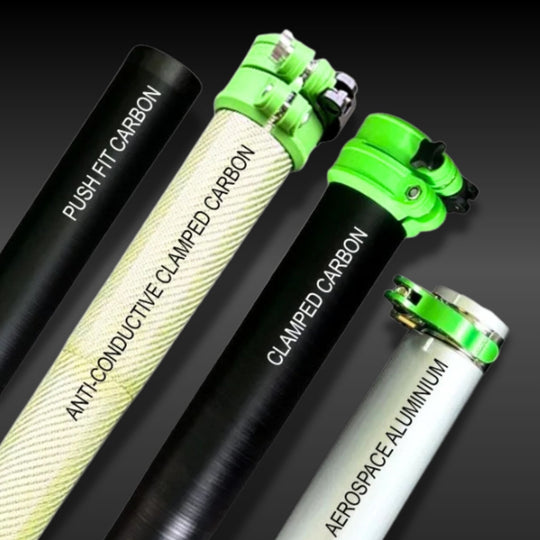
The GVS Professional Pole Systems hub is built around this principle: choose the application first, then confirm reach, connection and material.
Know where equipment overlap stops
Multi-use equipment is valuable, but it can create false confidence if compatibility is judged by appearance alone.
A pole that accepts one attachment does not automatically make every attachment suitable. A hose intended for water should not automatically be used for chemicals. A fitting that physically connects should not be assumed pressure-rated. A gutter-vacuum pole and a telescopic water-fed pole can both reach the same elevation while behaving very differently in day-to-day use.
Before reusing equipment across services, confirm:
- the intended application;
- connection and thread standard;
- working pressure where relevant;
- chemical compatibility where relevant;
- hose routing;
- working-end weight;
- and whether the complete configuration can be controlled properly.
Shared equipment is useful. Shared assumptions are not.
Do not confuse equipment overlap with competence
Owning an attachment does not automatically mean the business is ready to sell the service.
Roof cleaning requires surface and method knowledge. Softwashing introduces chemical controls. Pressure washing requires an understanding of surface suitability, water supply, nozzle choice and runoff. Window cleaning has its own water-treatment and workflow considerations.
Before marketing a new service, make sure you understand:
- what surfaces or situations the method suits;
- what can go wrong;
- how the equipment should be inspected and maintained;
- what customer expectations need to be set;
- and what additional risk controls are required.
Review your insurance as the activities carried out by the business change, and make sure the services you actually provide are accurately described to your insurer.
Plan the van and working system before buying more equipment
A multi-service exterior-cleaning van can become crowded quickly.
A gutter-clearing setup may already include a vacuum, pole sections, hose, camera, generator, spares and PPE. Window cleaning can add purification equipment, reels and water storage. Pressure washing may add another machine, pressure hose and surface cleaner. Softwashing introduces chemical storage and application equipment. Roof cleaning adds scraper heads, blades and additional pole components.
Before ordering the next complete system, check:
- where the equipment will be stored and secured;
- whether the vehicle has sufficient payload for the complete working load;
- how wet or contaminated equipment will be separated from clean brushes and electrical equipment;
- where chemicals will be stored;
- and whether the setup still allows safe, efficient access to the equipment you use most often.
A van is not well designed merely because everything fits through the doors.
Chemicals and wash water change the job
If you expand into softwashing or other chemical cleaning, the product label and Safety Data Sheet are starting points rather than a complete working method. Where hazardous substances are used at work, the actual hazards, exposure and controls need to be assessed for the task.
Current HSE COSHH guidance explains the assessment process for hazardous substances.
Pressure washing and chemical cleaning also create wash water that may contain cleaning products, silt, oil, organic matter or material removed from the surface.
Do not assume the nearest surface-water drain is a suitable disposal route. In England, current Environment Agency guidance explains that surface-water drains discharge directly to the environment and that contaminated water needs to be managed appropriately.
See the pollution-prevention guidance for businesses when planning wash-water controls in England, alongside the requirements that apply where you operate.
Build one complete service at a time
A simple expansion process is usually stronger than buying several half-finished systems at once.
- Record customer demand. Identify which additional jobs are repeatedly requested.
- Learn the service. Understand the surfaces, methods, risks and expected result.
- Audit what you already own. Identify equipment that is genuinely compatible with the new application.
- List what must be service-specific. Do not compromise on chemical compatibility, pressure ratings or the correct working attachment.
- Build the complete workflow. Include setup, operation, clean-up, storage and maintenance - not just the main machine.
- Review business requirements. Check insurance, risk controls, vehicle load, chemicals, water and waste implications where relevant.
- Test the process before promoting it heavily. Make sure the equipment and workflow work together as intended.
- Let real jobs guide the next purchase. Add specialist tools when they solve a repeated problem.
Which expansion route fits your business?
| What you are seeing now | Possible next service | Why it may fit |
|---|---|---|
| Customers want the visible roofline cleaned as well as the gutters cleared | External gutter, fascia and soffit cleaning | Closely related property area with useful high-reach equipment overlap |
| You want more repeat residential work | Window cleaning | Creates an ongoing maintenance service with its own water-fed workflow |
| Quoting and proof of completion are becoming more important | High-level inspection | Improves the existing gutter service without requiring another major cleaning system |
| You repeatedly encounter heavy roof moss feeding debris into gutters | Roof cleaning | Addresses a related maintenance problem while keeping the gutter vacuum useful for debris clean-up |
| Customers ask about organic staining on suitable facades and exterior surfaces | Softwashing | Adds controlled chemical-treatment capability where the surface and product are compatible |
| You receive regular driveway, patio or hardstanding enquiries | Pressure washing | Adds mechanical cleaning capability for suitable hard exterior surfaces |
Our practical recommendation
If gutter clearing already works for your business, expand around real customer demand and one complete service at a time.
Inspection and exterior fascia or soffit cleaning can strengthen the service you already provide. Window cleaning can add a repeat maintenance route. Roof cleaning can make sense where moss is a regular problem. Softwashing and pressure washing can open wider exterior-cleaning work, but they also introduce more specialised equipment, surface knowledge and controls.
Reuse good equipment where it is genuinely designed for more than one application, but do not build a professional service around improvised compatibility.
The aim is not to offer every exterior-cleaning service. It is to build a focused set of services that your customers want, your equipment can support and your business can deliver consistently well.
Quick Answers
Frequently Asked Questions
Find concise answers to common questions covered by this guide.
Can I add other exterior-cleaning services later?
Which exterior cleaning service should I add first?
Can I use the same poles for different exterior cleaning services?
Is roof cleaning a good service to add after gutter clearing?
Do gutters need clearing after roof cleaning?
Do I need COSHH paperwork for softwashing?
Do I need different insurance when I add another cleaning service?
Related Advice
Keep Learning
Continue with related GVS guides before moving into equipment or support.


Continue From Here
Use The Guide, Then Choose What To Do Next
Keep researching or move into the most relevant GVS equipment or support area for this topic.
Need A Product-Specific Answer?
Need Help Applying This To Your Setup?
Tell the GVS team what you are cleaning, your working height and the equipment you already have. We can help you check the practical next step.